
What You’ll Find Out In This Article
The Frictionless system delivers the following benefits to technology and engineering businesses:
- Creates a growing, successful business with long-term resilience and high value
- Enables the business owner to achieve their personal desires and aspirations freeing them of daily involvement
- Gives the owner and the business a clear Direction and Destination
- Enables the whole business to successfully Focus on achieving the Direction
This article briefly introduces the key principles of the system and why any business can benefit from understanding and applying them.
The Frictionless System Was Designed For You
The Frictionless system has been designed for technology and engineering companies like yours, to help them create high-value organisations with strong foundations and long-term resilience.
The principles used are based on years of experience working with successful entrepreneurs and organisations in technology and engineering. The system maps the journey of a successful company and uses tried and tested methodologies to quickly identify sources of Friction, those things that hold it back. It is a structured yet flexible approach that adapts to the specific needs of the individual business.
The key problems we work with owners to address include:
- Feeling ‘stuck’ – the business needs to change but the owner is unsure of what to change or the best way to do it
- The owner spends too much time working in the business and is a key part of the everyday ‘work’ of the organisation
- Issues with sales: insufficient sales; problems attracting enough of the ‘right’ customers; no control over lead generation as most business is word-of-mouth
- Issues recruiting the right people
- Uncertainty about structuring for effective growth
Where Are You Going?
In this section we will see that the most successful people, organisations and businesses all have one thing in common: a clear vision of what they stand for, clear goals, why they want to achieve them, and a plan to make them happen.

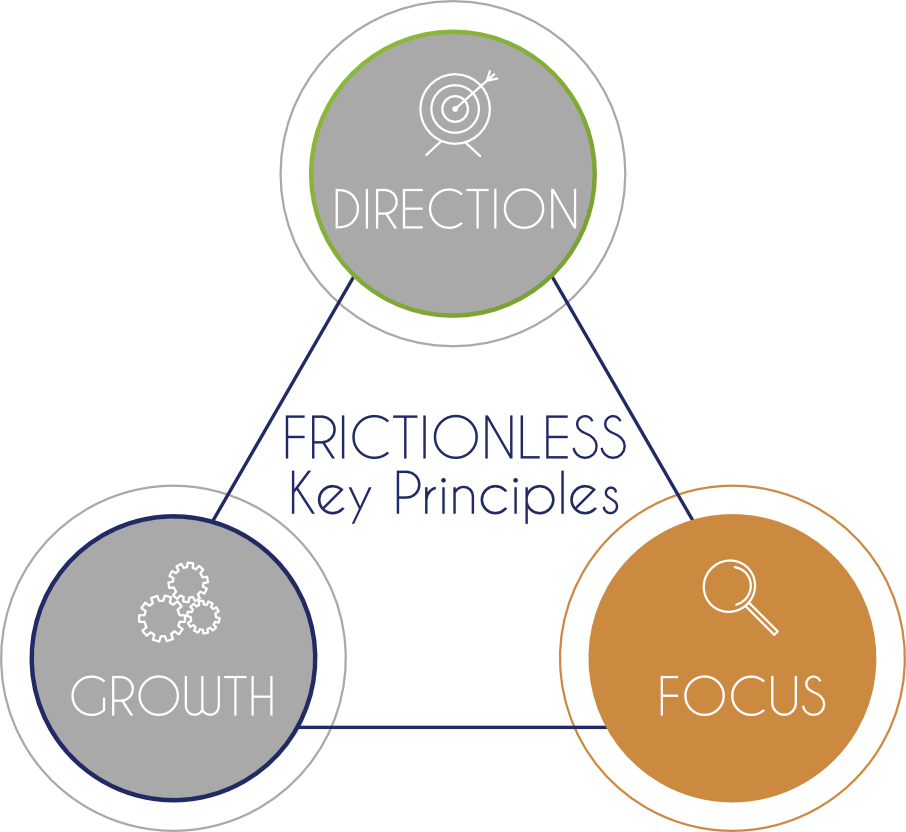
The biggest difference between a highly successful business and the rest of the field is a strong commitment to a vision and a set of tangible goals that the organisation wants to achieve. This is “Direction”.
Most small to medium sized businesses have no formal Direction. Sometimes the owner may have aspirations, but these informal ideas are rarely written down, not measurable and not communicated or rolled-out to the wider business.
For the owner especially, and to a lesser extend everyone else in the business, there must be alignment between business Direction and the long-term aspirations of the owner. This ensures that the Direction is relevant and personally important to the owner and won’t be forgotten. If alignment can be achieved for all staff then this is a further win but requires more focus to achieve.
Secondly, the Direction must include the reasons why the business does what it does. Research has shown that people buy into your reasons why you do what you do far more than what you do. This includes your staff, your customers, prospects, suppliers and partners. For an example, look no further than Apple, that sells its products from a branding and ‘think different’ position rather than ‘fastest processor’ specmanship.
This is an even bigger problem where there are multiple owners in the business, each with different aspirations. This can lead to all sort of conflict and problems down the line as the business develops and those aspirations begin to surface.
Setting a clear Direction, then, is the first and most important step in transforming a business.
We run Direction Day workshops when we kick-off work with new clients. These are intense day-long sessions with follow-up that gives the organisation its Direction. We also run these are a stand-alone product for any business that wants clarity on Direction, and you can find out more about that HERE.
Is Everyone Pulling On The Same Rope?
It is not enough to simply create a Direction and then expect it to magically happen, it requires Focus to drive the right action throughout the organisation.
In this section we’ll explore what Focus means and how it ensures that the organisation moves in the right Direction, despite the daily pressures, challenges and issues that will inevitably arise.
If the business gets as far as creating Direction and having a plan, the next step is to do something with it.
This means creating actionable work for everyone in the business so that the whole organisation acts as one to achieve the common aim.
Focus includes setting goals for departments and individuals and creating plans to make them happen. It means making sure we can measure progress, so we know that what we expect to happen is actually happening.
We must regularly review those measures and take corrective action if we find we’re drifting off course.
This helps avoid situations where, for example, sales are tasked with growing sales by 25% but no-one tells production that they’ll soon have to ship 25% more products.
Focus gives the owner measures and mechanisms for driving the business driving towards its Direction, and allows for informed decision making when things drift off course.
At its most refined level, Focus aligns the goals of each individual with the goals of the company. Imagine how powerful that would be in your organisation, knowing that your workforce are personally gaining something through their work in your organisation. The resulting motivation and personal responsibility creates step-change in productivity and loyalty, if you can pull it off.
Your Crystal Ball
Before we look at our final principle, Growth, we’ll first quickly explore why knowledge of the journey ahead is vital to our long-term success

Every business is unique and on its own particular journey. However, within the technology and engineering sector, there are five distinct stages to the evolution of a business. By understanding these stages, the business can get a deeper understanding of where it is right now and the challenges it faces. Importantly, it can also get clarity about the journey ahead, what’s waiting for it. It can use this knowledge to prepare and be ready and to avoid being surprised and having to take knee-jerk action to address emerging challenges.
You can find out which stage your business is at by using on online tool HERE
Build Strong Foundations
In this section, we’ll look at Growth in its widest sense including the growth of sales and profit and also the growth of the capability and structure of the organisation.

As the sales in our business grow, so must the organisation itself. If you sell more stuff you’re going to need more people and production/fulfilment capacity to cope.
Also, as the business grows, so does the depth of the roles and the complexity of the systems needed.
For example, the role of production manager might have been simple when the business was small, involving a small production team and a few machines. As the business grows, the job involves teams of people, lots of machinery, investment, maintenance, planning and scheduling. It is not unusual for the role to outgrow the incumbent.
With foresight, the business can anticipate these issues and understand the structure it will need in the future years and months to cope with its growth.
In the case of our production manager, we can decide perhaps years ahead of time whether the current person is capable and interested in growing with the role through training and development or whether we will, at some point soon, face the difficult decision of hiring someone externally.
Likewise the entire infrastructure of the business must evolve to keep pace with growth and the people themselves must be constantly developing and learning.
At some point in the evolution, the founder themselves may find that the business outgrows them and might decide to step aside and make way for a someone to take the top job.
Growth also includes increasing sales with the most desirable customers and profitable work. We must move from a word-of-mouth only business to one where we attract new business through carefully managed sales and marketing.
The pillar that the Frictionless system uses to address all this is Growth, making sure the organisation is growing to support the Direction and Focus.
Friction Gets In The Way
Anything that holds the business back from achieving its goals is Friction. This includes big picture stuff like a lack of Direction right down to the smallest and most persistent issues.
The Frictionless systems takes a pragmatic approach to identifying and resolving causes of Friction, to allow it to move consistently towards its goals.
At the top level, the system makes sure the key pillars are in place so we can measure and manage the work of the organisation.
At a lower level, we can often find that small but persistent issues occur which, if we lump them all together, collectively create a huge drag on the organisation. That is Friction.
The good news is that it can usually be eliminated quickly, easily and at little or no cost, resulting in huge benefits to the organisation and the frustration of its staff.
Conclusion
The Frictionless system is a complete top-down system for Technology and Engineering companies.
To help businesses we offer several tools that are helpful. Are online tool HERE helps you to identify which stage of business evolution you are at.
We also offer day-long Direction Day workshops where we work with the business to establish a clear Direction. This is a critical first step in making any changes inside a business. From this point, the business can proceed on its own or with our help to start moving in its chosen Direction
To talk to us about your specific needs and challenges book a call HERE.
Recent Comments